 Challenge completed
New mobility with autonomous drones
Key aspects of sustainable consumption and production are the underlying supply chains and the transportation of goods. Work together with Bell to revolutionize current mobility solutions using autonomous drones and create smart solutions to supplement existing transportation models with more efficiency and sustainability.
To support you in your idea and team generation process, you have the opportunity to participate in one of our digital Design Thinking Workshop - register here or find more information here.
Specifications about the drone
Model: APT 20: Technical specifications
- Range: 18 mi | 29 km
- Speed: 90 kts | 166,7 km/h
- Gross weight: 55 Ibs | 24,9 kg
- Height: 3 ft | 91,44 cm
- Width: 5 ft | 152,4 cm
Model: APT 70: Technical specifications
- Range: 35 mi | 56 km
- Speed: 110 kts | 203.7 km/h
- Gross weight: 300 lbs | 136 kg
- Height: 6 ft | 182,88 cm
- Width: 9 ft | 274,3 cm
- Max cargo load: 70 bls | 31 kg
Additional information:
- Autonomous vertical take-off which uniquely transitions to wing-borne flight, providing multi-copter payload capability with fixed wing speed
- The detachable pod in the middle of the aircraft can accommodate payload. The pod can be modified to fit customer-specific mission requirements
- The aircraft is capable of transporting a cargo load of up to 31 kg (70lb). It can be configured to carry time and value-sensitive medical products, such as blood and plasma
- The UAV can fly at a maximum speed of 203.7km/h (110kts) and can attain a range of 56 km when laden with maximum payload. The empty aircraft offers a range of more than 100 km when fitted with an additional 32 kg battery. The maximum endurance of the aircraft is 55 minutes
Further information: https://www.bellflight.com/products/bell-apt
Selected tests and initiatives
The APT 70 is one of a family of cargo drones which Bell is developing for package delivery, disaster relief, offshore resupply, and other logistics missions for civil and government users.
Bell APT 70 has participated in the development and testing of autonomous transport drones. Here is more information about selected tests and initiatives.
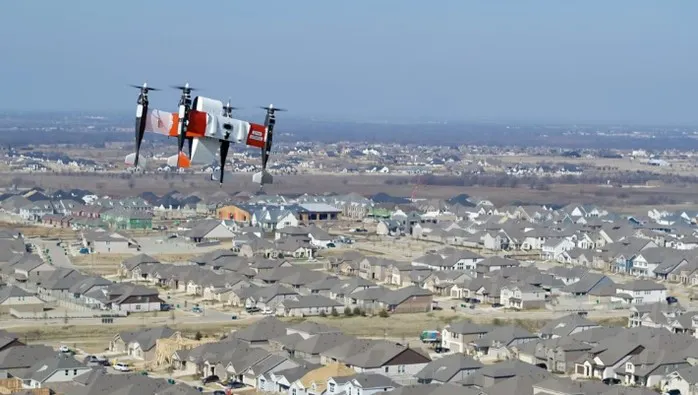
Feb. 2021: Hillwood and Bell Demonstrate Autonomous Package Delivery at Mobility Innovation Zone (https://bit.ly/3ayejam)
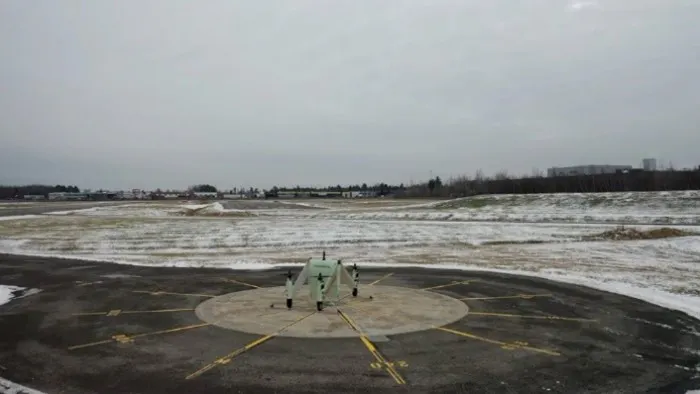
Jan. 2021: Bell Evaluates Unique APT Configuration in Canada in collaboration with ARA Robotics (https://bit.ly/3xja9g8)
This technology demonstrator is co-funded by the Canadian Technology Demonstration Program (TDP). The TDP allows Bell to test new technologies that promote advances in autonomy and electric propulsion. Through close partnerships with small and medium-sized-enterprises, Canadian academic and government organizations, Bell leverages valued expertise and resources to bring innovation to Canada and deliver advanced solutions to the world.
Oct. 2020: Bell Learned That Its APT 70 Cargo Drone Can Integrate With Manned Traffic During A Demo Flight. What Did It Learn About Avoidance and 5G? (https://bit.ly/32IclQ4)
Bell successfully flew its Autonomous Pod Transport (APT) 70 cargo drone autonomously through the complex Dallas-Fort Worth area airspace, simulating a critical medical transport mission. The flight was undertaken as part of NASA’s Systems Integration and Operationalization demonstration, which seeks to foster progress toward commercial use of unmanned aircraft systems.
Sep. 2020: Bell APT 70 Successfully Completes NASA’s Systems Integration and Operationalization Activity (https://bit.ly/3xjKOCH)
“This successful demonstration highlights the great potential for the APT 70 to complete complex missions for businesses and healthcare providers,” said Michael Thacker, executive vice president, Innovation and Commercial Business. “With teammates like NASA, we can carve a path forward for future commercial operations to solve the cargo and goods transportation challenges our world currently faces.”
An overview of drones and air mobility trends in Germany:
- March 2021: BMVI launches new funding program. Andreas Scheuer: We are giving drone innovations a boost (BMVI - BMVI startet neues Förderprogramm)
- April 2021: German Drone Market Reaches New Altitudes (German Drone Market Reaches New Altitudes - YouTube)
- June 2020 (Germ.): 60.000 Piloten für Flugtaxis gebraucht
- 2018: „Flugtaxi“ made in Germany (Volocopter: Ein Flugtaxi made in Germany - Wirtschaft - Tagesspiegel)