Challenge completed
Alternatives to electrodeposited coatings
Traditional electroplating in watchmaking presents challenges related to security, safety, and ecological impact. In partnership with this Swiss watchmaking company, we're seeking novel coating solutions for gold and nickel (or nickel-alternatives), exploring new techniques & materials. Join us in pioneering safer, sustainable innovations and scale your approaches with our partner, a renowned Swiss watchmaking company.
Who can take part? Open to startups, tech companies, researchers, and materials innovators with a knack for advancing coating & sustainability
Guidelines and Specifications
The following section gives you an detailed overview regarding the criteria and requirements for the searched for coating solution.
Material and Process Compatibility
- Substrate Compatibility: Solutions must work with existing substrates such as copper alloys (Ecobrass, Pfinodal, etc.) and steel alloys (Durnico, etc.), and be suitable for complex geometries like 3D parts, holes, and cavities.
- Processes in Use: The solution should be compatible with the use of racks and/or baskets for industrial processes or it should be easily integrable with those industrial systems when scaling up.
Coating Specifications
- Thickness and Uniformity: Coatings must meet the required thickness range as described below. For gold, ensure color consistency with NIHS 67-50 (gold 2N).
- Order of Coatings: Currently, the typical sequence includes a nickel layer (0.3 to 1.5 µm ±0.2 µm) followed by a gold layer (0.1 to 0.5 µm). The use of only nickel (or nickel-alternatives) or only gold can be also considered when the functional and aesthetic properties are met.
- Component Dimensions: Solutions must be effective across components with dimensions ranging from 1x1 mm² to 10x10 mm², and thicknesses from 0.05 to 1 mm.
Specific Considerations for Gold and Nickel
- Gold: Focus on maintaining aesthetic quality, color consistency (2N standard), and adherence.
- Nickel: Focus on functionality, including corrosion resistance, adherence, and tribological properties, with openness to alternative materials.
Safety & Environmental Impact
- Non-Toxicity: Use safe, non-toxic, and/or recyclable materials.
- Eco-Friendliness: The solution should minimize environmental impact, addressing security and worker safety concerns.
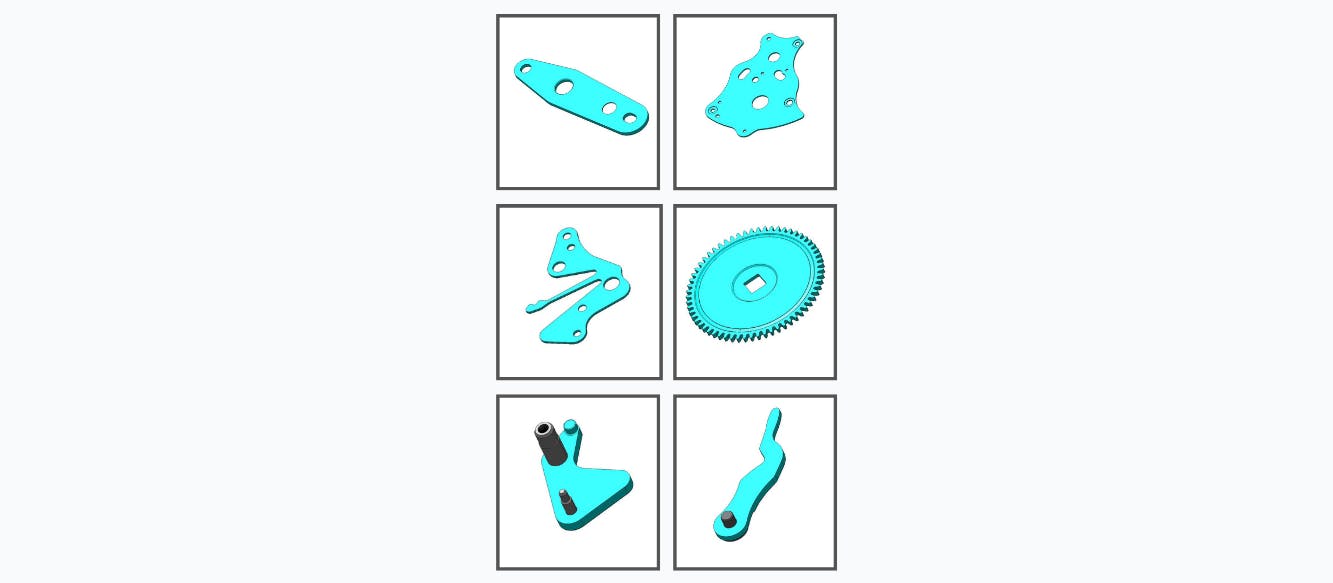
Watch components
The section gives you some visual information about the affected components.